Tag Archives: Publications

November 2017

Consumptive Chic: The Postfeminist Recycling of Camille in Baz Luhrmann’s Moulin Rouge!

in Prostitution and Sex Work in Global Cinema by Katie N. Johnson

Abstract

Prostitutes, especially hookers-with-hearts-of-gold, have long tugged at the heartstrings of audiences on stage and in film. While Baz Luhrmann’s Moulin Rouge! (2001) offers a funky—if not campy—take on the turn-of-the-century Parisian underworld, the film is nonetheless an unmistakable retelling of Dumas fils’ nineteenth-century melodrama Camille (La Dame aux camélias). In fact, Lurhmann’s prostitute-character Satine emblematizes the ‘penitent whore,’ the figure that is scrutinized for her sexual transgressions, who expresses a sense of worthlessness, repents for her sins, and is ultimate punished—usually by death—to reinstate patriarchal order. As Satine, the Sparkling Diamond of the Moulin Rouge, Nicole Kidman is often fetishistically shot with a blue lens, giving her a necrophilic look, creating what Johnson calls ‘consumptive chic.’ The film’s cinematography highlights her fragility, pallid form, and glistening corpse-like whiteness. Satine’s whiteness also functions powerfully as a racial category, which is key to her desirability. Although Luhrmann’s postmodern approach is entertaining, the film eviscerates years of scholarship regarding representations of fallen women, the regulation of women’s sexuality, the politics of women’s work, the process of racialization, and commercialized sex. The film’s popularity can be seen a barometer of dominant culture’s attitudes toward the postfeminist moment and demonstrates the formative role of film in perpetuating misogynistic narratives, whilst giving lip service to women’s liberation. Johnson’s essay takes up the question of representing the hooker-with-a-heart-of-gold and its resonance for postfeminism and media studies by analyzing Cukor’s Camille (1936), two versions of Moulin Rouge (John Huston 1952 and Luhrmann 2001), and the ‘Lady Marmalade’ music video (2002) produced by Missy Elliot.

Distorted Antigones: Dialectics and Prostitution in Lola and Shirins Hochzeit

in Prostitution and Sex Work in Global Cinema by Danielle Hipkins and Katharine Mitchell by Teresa Ludden

Abstract

Rather than interpreting R.W. Fassbinder’s film Lola and Helma Sanders’s Shirins Hochzeit through the usual angle of genre and melodrama, this essay used Hegelian dialectical philosophy and gender theories to analyse the prostitute characters. Taking Walter Benjamin’s idea of the prostitute as embodiment of contradictions, and Hegel’s notion of women as the ‘irony of the community’, I examined the symbolism surrounding Lola which constantly mutated to figure her as a revolutionary force outside dialectics; as outside but also inside associated with the dialectical relations between public and private; as repressed individuality which, as such, maintains the community. By making dialectics become visible as the site of constant tensions she exposed the workings the dialectic and alluded to the dysfunction of the dialectic because of the domination of the universal. Shirin, on the other hand, is positioned less complexly as marginal but oppositional voice, and the circular device of the resuscitated speaking tragic heroine created a central tension between the desire for a different speaking position and acknowledgement of the danger of repeating the same stories.

“Le Traviate: Suffering Heroines and the Italian State Between the Nineteenth and Twenty-First Centuries”

in Prostitution and Sex Work in Global Cinema by Danielle Hipkins and Katharine Mitchell

Abstract

In this chapter we will consider the relationship between what was considered the most successful operatic melodrama in the newly emerging nation state of nineteenth-century Italy, Verdi’s La traviata, first performed in 1853, and a 2012 film addressing the theme of the suffering female and the doomed romantic relationship in the context of prostitution, Un giorno speciale (Francesca Comencini). In the first section of this chapter, we examine the extent to which this trope gained significance through operatic melodrama and discourses surrounding prostitution in the late nineteenth century, and what its possible effects were. Then we will look at the way in which recent discourse about prostitution is mediated through the trope of the suffering (girl) heroine in Un giorno speciale, a film addressing the recent events in Italy. We suggest that re-reading these texts together enables us to see beyond the suffering prostitute heroine’s apparent reduction to cypher, and towards her potential to open up questions about structural inequalities within the body politic. We argue that Comencini’s self-conscious recycling of the trope is typical of a new engagement with the girl figure as a ‘suffering actor’, identified by Anita Harris and Amy Shields Dobson as a trope for overcoming the dichotomy between agency and victimhood in the post-girl power period.

Deborah and Her Sisters
How One Nineteenth-Century Melodrama and a Host of Celebrated Actresses Put Judaism on the World Stage

by Jonathan M. Hess

Before Fiddler on the Roof, before The Jazz Singer, there was Deborah, a tear-jerking melodrama about a Jewish woman forsaken by her non-Jewish lover. Within a few years of its 1849 debut in Hamburg, the play was seen on stages across Germany and Austria, as well as throughout Europe, the British Empire, and North America. The German-Jewish elite complained that the playwright, Jewish writer S. H. Mosenthal, had written a drama bearing little authentic Jewish content, while literary critics protested that the play lacked the formal coherence of great tragedy. Yet despite its lackluster critical deborah and her sistersreception, Deborah became a blockbuster, giving millions of theatergoers the pleasures of sympathizing with an exotic Jewish woman. It spawned adaptations with titles from Leah, the Forsaken to Naomi, the Deserted, burlesques, poems, operas in Italian and Czech, musical selections for voice and piano, a British novel fraudulently marketed in the United States as the original basis for the play, three American silent films, and thousands of souvenir photographs of leading actresses from Adelaide Ristori to Sarah Bernhardt in character as Mosenthal’s forsaken Jewess.
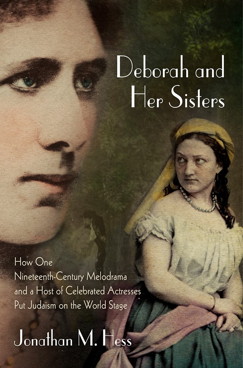
For a sixty-year period, Deborah and its many offshoots provided audiences with the ultimate feel-good experience of tearful sympathy and liberal universalism. With Deborah and Her Sisters, Jonathan M. Hess offers the first comprehensive history of this transnational phenomenon, focusing on its unique ability to bring Jews and non-Jews together during a period of increasing antisemitism. Paying careful attention to local performances and the dynamics of transnational exchange, Hess asks that we take seriously the feelings this commercially successful drama provoked as it drove its diverse audiences to tears. Following a vast paper trail in theater archives and in the press, Deborah and Her Sisters reconstructs the allure that Jewishness held in nineteenth-century popular culture and explores how the Deborah sensation generated a liberal culture of compassion with Jewish suffering that extended beyond the theater walls.

Jonathan M. Hess is the Moses M. and Hannah L. Malkin Distinguished Professor of Jewish History and Culture and Chair of the Department of Germanic and Slavic Languages and Literatures at the University of North Carolina at Chapel Hill. He is author of several books, including Middlebrow Literature and the Making of German-Jewish Identity and Germans, Jews and the Claims of Modernity.
Spring 2017

Bohyeong Kim

Abstract

This study explores the birth of the popular radio serial drama under the Cold War doctrine of national broadcasting in 1950s South Korea. By examining texts, critiques, production practices, and writers, I interrogate how the anti-Communism propaganda mandate was negotiated in radio drama, influenced not only by the South Korean government and the field of radio production but also by the U.S. cultural Cold War programs and Americanization. As the result of historical contingencies within radio-drama production, the propaganda mission of national broadcasting morphed into “vulgar” melodrama, focused on romantic triangles and urban lifestyles. Whereas themes contrasted with the government intention, the genre effectively supported the purposes of anti-Communist propaganda by promoting the American way of life, wherein individual freedom was identified with capitalist consumer modernity. In this vein, serialized melodrama heralded an important shift in radio propaganda from direct and overt anti-Communism to a more ambiguous and recreational direction. This complex process is considered in relation to Americanization of radio writers and the U.S. cultural Cold War efforts, such as the Broadcasters Exchange Program.

Registers of action: melodrama and film genre in 1930s India

Screen, Volume 58, Issue 1, 1 March 2017, Pages 64–72,

Is there some comparative and connected way of thinking through film genre, both in the local contexts of production and more regionally and globally? In the early period of Indian cinema there were key patterns of film circulation and, alongside the iconic ‘national’ genre of the mythological, it would appear that the action serial/stunt movie and adventure/fantasy film remained a staple attraction.1 While genre elaboration took place in the 1920s, with historical and social films becoming part of cinema’s attractions, it was only in the 1930s that the notion of ‘the social’ acquired a cultural cachet and reformist zeal, not just in one site but across colonial India’s multiple and overlapping language territories.2 A research agenda has emerged recently within film studies to unsettle this canonical account of cinema’s unfolding narrative.

In critical studies on historical television programmes, the affective qualities of televisual memory have been discussed mainly in terms of nostalgia. This article argues that conceptualizing the affective modes of relating to the past in more varied ways can help us to better understand the politics of memory on television. As a case study, the article analyses Finnish Broadcasting Company Yleisradio’s historical drama and documentary series that deal with the relationship between Finland and the Soviet Union. The article identifies three affective modes in the programmes: irony, nostalgia and melodrama. Each of these modes offers different possibilities for critiquing, understanding and justifying the past. By studying televisual memories of the Soviet Union in a non-socialist country with important political, economic and cultural ties with the socialist bloc, the article moreover questions a clear East–West binary in studies on post-socialist memory.

June 2017

Scars and Wounds: Film and Legacies of Trauma

Edited by Nick Hodgkin and Amit Thakkar

About: This book examines recent cinematic representations of the traumatic legacies of national and international events and processes. Whilst not ignoring European and Hollywood cinema, it includes studies of films about countries which have been less well-represented in cinematic trauma studies, including Australia, Rwanda, Chile and Iran. Each essay establishes national and international contexts that are relevant to the films considered. All essays also deal with form, whether this means the use of specific techniques to represent certain aspects of trauma or challenges to certain genre conventions to make them more adaptable to the traumatic legacies addressed by directors. The editors argue that the healing processes associated with such legacies can helpfully be studied through the idiom of ‘scar-formation’ rather than event-centred ‘wound-creation’.


Summer 2017

 Hasan and Marika:Screen Shots from a Vanishing Egypt’ 

Joel Gordon

Abstract:

This essay analyzes an Egyptian comedy film from the late 1950s as a window—one of the last cinematically—into the vanishing world of Egypt’s minority populations in the aftermath of the Suez Crisis and in the midst of nationalization and Egyptianization. Hasan and Marika (1959) focuses on one particular community, Egyptian Greeks. It borrows heavily from ethnic/religious minority tropes from the long-standing canon of Egyptian film and theater, in particular several classic works that deal with Muslim-Christian-Jewish pairings. It speaks to broader issues of what some scholars have noted to be a shifting or narrowing Levantine ethos. Concurrently, it raises questions about social and cultural transformations in the immediate postcolonial moment. This essay reads the film within the contexts of Egyptian social and cultural history, the position of the Greek community, ongoing limitations to true social integration, and historical questions about the Greek community’s demise. It also reads the film as a deliberate, if at times whimsical, commentary upon Egypt’s changing social landscape, comparing it to other works and later nostalgic depictions of Egypt’s lost multiculturalism.


“Beyond Sadness: The Multi-Emotional Trajectory of Melodrama”

Julian Hanich, Winfried Menninghaus, Steve Wilder

Abstract:

In this article we investigate the astonishing variety of emotions that a brief scene in a film melodrama can evoke. We thus take issue with the reductive view of melodrama that limits this genre’s emotional effects to sadness, pity, and tear-jerking potential. Through a close analysis of a melodramatic standard situation—a “news of death” scene—in Alejandro González Iñárritu’s 21 Grams (2003), we reveal the emotional dynamics and the high density as well as rich variety of affective phenomena likely to be experienced during the trajectory of this two-minute scene.


“‘She killed not from hate, but from love’: motherhood, melodrama and mercy killing in the case of May Brownhill” by Lizzie Seal

Abstract:

This article examines press portrayals of and public reactions to a ‘mercy killing’ in 1930s England. May Brownhill, sixty-two, killed her ‘invalid’ adult son by giving him an overdose of aspirin and poisoning him with coal gas. Through the conventions of melodrama, May was portrayed in the press as a respectable, devoted and self-sacrificial mother deserving of sympathy. The case also resonated with contemporary debates about euthanasia. It is an historical example of popular leniency, whereby although guilty of a crime, an individual is not seen as deserving of punishment. The case contributes to our understanding of how popular leniency was shaped by gender, class and age, and by contemporary views on ‘mercy killing’.


“Melodrama, Masochism, and Biopolitical Encounters in The Fosters by Jaime Brunton

Excerpt:
“Since the television drama The Fosters, which centers on the daily struggles of two lesbian moms (Stef Foster and Lena Adams) and their multi-ethnic family of foster and adoptive children, debuted on ABC Family in 2013, the show has garnered numerous awards and nominations, including honors from the Teen Choice Awards, The Television Academy, and the Television Critics Association. More notably, the show has been nominated for three awards by the Imagen Foundation (whose mission is “To encourage the positive portrayals of Latinos in all forms of the entertainment media”), has one win and two nominations from the Gay & Lesbian Alliance Against Defamation (GLAAD) Media Awards for Outstanding Drama series, as well as a GLAAD Vanguard Award for its executive producer, Jennifer Lopez. Add to this acclaim the show’s popularity, and its clear that The Fosters has struck a chord with American television audiences and critics. While part of the show’s appeal no doubt rests in its representations of LGBTQ people and people of color (as its awards suggest) and its dealing with topical issues such as gay marriage and racial profiling, it is also worth noting that the specific ways in which these issues are handles are also perhaps part of the attraction for audiences. Working against simplistic victim-perpetrator narratives, the show instead presents characters who work the biopolitical system from the inside—in ways that, in typical melodramatic fashion, are masochistic and destructive, and yet ultimately result in a complicated form of agency and power. In doing so, The Fosters offers a not-so-subtle critique of the biopolitical state as well as of traditional models of “resistance” to power.”

Replaying and Rediscovering The Octoroon by Lisa Merrill, Theresa Saxon

Excerpt:

For over 150 years, productions and adaptations of Irish playwright Dion Boucicault’s explosive 1859 melodrama The Octoroon have reflected differing and sometimes contentious meanings and messages about race and enslavement in a range of geographic locations and historical moments. In this melodrama, set on a plantation in Louisiana, audiences witness the drama of Zoe Peyton, a mixed-race, white-appearing heroine who learns after the sudden death of her owner/father that she has been relegated to the condition of “chattel property” belonging to the estate, since she was born of a mother who had herself been enslaved.2 Rather than submit to a new master after having been sold at auction, Zoe poisons herself and dies, graphically, onstage. [End Page 127]

The play is famous in the annals of theatre and performance history for reactions to its depiction of slavery in antebellum America, and for the various rewrites to which the script was subjected in a Britain that had already abolished the slave trade. In London, in 1861 Boucicault famously rewrote the ending, allowing the heroine to survive and be united with her white lover in another (presumably more just) country, ostensibly England. Critical accounts of this adaptation have relied upon newspaper reports, as the playscript itself was never published. Within a short time Boucicault changed the ending again, this time leaving Zoe silent in the arms of her lover as both witnessed the burning of the steamboat Magnolia. This four-act edition was published widely, and it and the original US version have formed the basis for most critical assessments of The Octoroon. A key assumption so far has been that this four-act version became an authoritative text for UK productions and thus Zoe died no more on British stages. But we have found this not to be the case.

Here, we discuss our archival discoveries of Octoroon promptbooks and playbills that reveal previously unknown aspects of the play’s stage history and critically illuminate the ways that the transatlantic theatre of the mid-nineteenth century portrayed enslaved mixed-race figures and interracial relationships. Although theatre historians have known about Boucicault’s original adaptation for over 150 years, no extant script for that original “British” version has heretofore been discovered. Now, however, our recent archival discoveries reveal portions of that long-missing script. At the University of Canterbury Kent we have discovered promptbooks of a later 1871 production of The Octoroon that provide specific textual evidence and blocking details that represent the first amended version as witnessed by London audiences a decade earlier, and described at the time in the London press. In addition, in the same archive we have uncovered evidence, which we discuss below, establishing that multiple versions of The Octoroon were being staged simultaneously, thereby further decentering nineteenth-century perceptions of both mixed-race bodies and contemporaneous binary definitions of race, thus complicating the received narratives of race and reception regarding this play.

Moreover, in other archives we have found evidence that The Octoroon appeared on the colonial stages of Australia a full ten months before it was staged in London and therefore before Boucicault changed the ending. Our exploration of the performance history of The Octoroon in Australia further illustrates the potential shifting meanings of racial categories and representations of enslavement in nations whose colonial histories were built on differing constructions of racist oppression, genocide, and slavery. Thus we discuss the ways that productions of The Octoroon have served as a unique vehicle for depicting the transatlantic and colonial cultural attitudes that surrounded, and tensions that emerged from, antebellum representations of racialization, racial hybridity, interracial desire, and enslavement on both sides of the Atlantic and across British colonies in Australia.

Furthermore, the actors’ promptbooks we have located contain several different endings written into the same script. Such promptbooks demonstrate the tensions between archive and repertoire so powerfully articulated by Diana Taylor.3 Although constructed in the form of printed scripts, these objects were used repeatedly by a number of…

March 2013

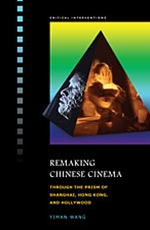
Remaking Chinese Cinema: Through the Prism of Shanghai, Hong Kong, and Hollywood by Yiman Wang

From melodrama to Cantonese opera, from silents to 3D animated film, Remaking Chinese Cinema traces cross-Pacific film remaking over the last eight decades. Through remaking chinese cinemathe refractive prism of Hollywood, Shanghai, and Hong Kong, Yiman Wang revolutionizes our understanding of Chinese cinema as national cinema. Against the diffusion model of national cinema spreading from a central point—Shanghai in the Chinese case—she argues for a multi-local process of co-constitution and reconstitution. In this spirit, Wang analyzes how southern Chinese cinema (huanan dianying) morphed into Hong Kong cinema through trans-regional and trans-national interactions that also produced a vision of Chinese cinema.
Among the book’s highlights are a rereading of The Goddess—one of the best-known silent Chinese films in the West—from the perspective of its wartime Mandarin-Cantonese remake; the excavation of a hybrid genre (the Western costume Cantonese opera film) inspired by Hollywood’s fantasy films of the 1930s and produced in Hong Kong well into the mid-twentieth century; and a rumination on Hollywood’s remake of Hong Kong’s Infernal Affairs and the wholesale incorporation of “Chinese elements” in Kung Fu Panda 2.

Positing a structural analogy between the utopic vision, the national cinema, and the location-specific collective subject position, the author traces their shared urge to infinitesimally approach, but never fully and finitely reach a projected goal. This energy precipitates the ongoing processes of cross-Pacific film remaking, which constitute a crucial site for imagining and enacting (without absolving) issues of national and regional border politics. These issues unfold in relation to global formations such as colonialism, Cold War ideology, and postcolonial, postsocialist globalization. As such, Remaking Chinese Cinema contributes to the ongoing debate on (trans-)national cinema from the unique perspective of century-long border-crossing film remaking.

About the author: Yiman Wang is assistant professor of film and digital media at the University of California, Santa Cruz.

October 2011

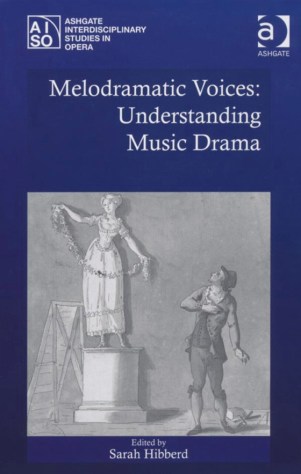
Melodramatic Voices: Understanding Music Drama edited by Sarah Hubbard

The genre of mélodrame à grand spectacle that emerged in the boulevard theatres of Paris in the 1790s – and which was quickly exported abroad – expressed the moral struggle between good and evil through a drama of heightened emotions. Physicalgesture, mise en scène and music were as important in communicating meaning and passion as spoken dialogue. The premise of this volume is the idea that the melodramatic aesthetic is central to our understanding of nineteenth-century music drama, broadly defined as spoken plays with music, operas and other hybrid genres that combine music with text and/or image. This relationship is examined closely, and its evolution in the twentieth century in selected operas, musicals and films is understood as an extension of this nineteenth-century aesthetic. The book therefore develops our understanding of opera in the context of melodrama’s broader influence on musical culture during the nineteenth and twentieth centuries. This book will appeal to those interested in film studies, drama, theatre and modern languages as well as music and opera.