Tag Archives: books

September 2017

“Women in White: Femininity and Female Desire in the 1960s Bombay Melodrama”

by Anupama Kapse in Film, Fashion, and the 1960’s edited by Eugenia Paulicelli, Drake Stutesman and Louise Wallenberg (Bloomington, Indiana: Indiana University Press, 2017), pp. 149-168.

Excerpt:

White as a Fabric and Architectural Frame
Clothes have served as a visual shorthand for representing the class or moral stature of popular characters in Bombay cinema since the time of its inception. The hero, heroine, villain, and others could be recognized as stock characters quite simply by what they were wearing: the heroine in a simple, demurely draped sari; the vamp with an “ostrich feather fan, gold wig studded with rhinestones, and leggings under a dark blue bikini bedecked with shiny doodahs”; the Anglicized hero in a black suit, shirt, and tie; the poet or artist in a pristine white kurta pajama; a rich father in a pipe and dressing gown; a poor father in a tattered dhoti and vest; and a villain (often acting as a buffoon) with hair dyed red, bow tie, and bright checked jacket. In the formulaic cinema of the 1960s, narrative patterns were established according to the easy recognition of this stock cast. Characters were simple and bordered on the stereotypical: the virtuous heroine, the sexualized vamp, the rich and overbearing father, and the lascivious villain were standard characters who stood for specific social types with well-defined moral values, or, sometimes, lack thereof.

Indeed, Bombay cinema mobilizes clothing as the primary sign of dramatic enunciation in highly coded and spectacular ways. If, as Peter Brooks has argued, melodrama is a form structured by the extreme polarization of good and evil, then, Bombay cinema is unapologetically melodramatic in its unfailing reliance on costume as an immediate and pervasive sign of this Manichean, black and white universe…
December 2015

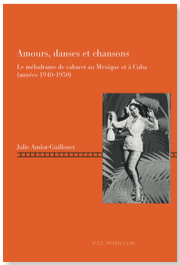
Amours, Danses Et Chansons: Le Melodrame de Cabaret Au Mexique Et a Cuba (Annees 1940-1950)

by: Julie Amiot-Guillouet


Amiot

L’ouvrage aborde la facon dont les coproductions entre Cuba et le Mexique debouchent dans les annees 1940-50 sur la mise en place d’un corpus de films designes comme des melodrames de cabaret, ou l’apport cubain, loin d’etre purement ornemental, contribue a renouveler profondement les normes generiques en vigueur dans le melodrame mexicain.

Cet ouvrage propose une analyse originale sur les relations cinématographiques entre Cuba et le Mexique à la période classique, à travers la construction de l’imaginaire particulier du mélodrame de cabaret, peuplé de danseuses de rumba au sang chaud et au cœur tendre. Les films dont elles sont les héroïnes sulfureuses s’enracinent dans les traditions génériques de l’industrie du cinéma mexicain, retravaillées par l’apport cubain à travers la musique, la danse, les paysages et les cabarets. Ils façonnent des personnages féminins originaux, introduisant des représentations inédites de danseuses et de femmes fatales qui luttent pour leur autonomie, et jouissent d’une grande liberté dans leur rapport avec leur corps. Cette coopération cinématographique s’explique par la volonté des producteurs, distributeurs et metteurs en scène mexicains de s’imposer sur les écrans cubains, tandis que les Cubains espèrent bénéficier de leur savoir-faire technique et artistique pour jeter les bases d’un cinéma national encore embryonnaire. Toutefois, l’atmosphère « tropicale » mise en œuvre dans les films s’avère un trompe-l’œil commercial lié au regard mexicain qui exotise Cuba. Un postulat dénoncé par les critiques et cinéastes cubains, en particulier au lendemain de la Révolution qui souhaite rompre radicalement avec ce cinéma commercial. La réception et l’historiographie de ces films en font ainsi de puissants révélateurs des imaginaires nationaux qu’ils contribuent à façonner et à véhiculer

June 2017

Scars and Wounds: Film and Legacies of Trauma

Edited by Nick Hodgkin and Amit Thakkar

About: This book examines recent cinematic representations of the traumatic legacies of national and international events and processes. Whilst not ignoring European and Hollywood cinema, it includes studies of films about countries which have been less well-represented in cinematic trauma studies, including Australia, Rwanda, Chile and Iran. Each essay establishes national and international contexts that are relevant to the films considered. All essays also deal with form, whether this means the use of specific techniques to represent certain aspects of trauma or challenges to certain genre conventions to make them more adaptable to the traumatic legacies addressed by directors. The editors argue that the healing processes associated with such legacies can helpfully be studied through the idiom of ‘scar-formation’ rather than event-centred ‘wound-creation’.