September 2017

“Women in White: Femininity and Female Desire in the 1960s Bombay Melodrama”

by Anupama Kapse in Film, Fashion, and the 1960’s edited by Eugenia Paulicelli, Drake Stutesman and Louise Wallenberg (Bloomington, Indiana: Indiana University Press, 2017), pp. 149-168.

Excerpt:

White as a Fabric and Architectural Frame
Clothes have served as a visual shorthand for representing the class or moral stature of popular characters in Bombay cinema since the time of its inception. The hero, heroine, villain, and others could be recognized as stock characters quite simply by what they were wearing: the heroine in a simple, demurely draped sari; the vamp with an “ostrich feather fan, gold wig studded with rhinestones, and leggings under a dark blue bikini bedecked with shiny doodahs”; the Anglicized hero in a black suit, shirt, and tie; the poet or artist in a pristine white kurta pajama; a rich father in a pipe and dressing gown; a poor father in a tattered dhoti and vest; and a villain (often acting as a buffoon) with hair dyed red, bow tie, and bright checked jacket. In the formulaic cinema of the 1960s, narrative patterns were established according to the easy recognition of this stock cast. Characters were simple and bordered on the stereotypical: the virtuous heroine, the sexualized vamp, the rich and overbearing father, and the lascivious villain were standard characters who stood for specific social types with well-defined moral values, or, sometimes, lack thereof.

Indeed, Bombay cinema mobilizes clothing as the primary sign of dramatic enunciation in highly coded and spectacular ways. If, as Peter Brooks has argued, melodrama is a form structured by the extreme polarization of good and evil, then, Bombay cinema is unapologetically melodramatic in its unfailing reliance on costume as an immediate and pervasive sign of this Manichean, black and white universe…

December 2015

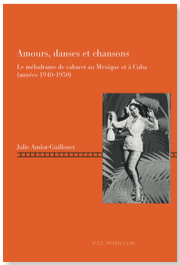
Amours, Danses Et Chansons: Le Melodrame de Cabaret Au Mexique Et a Cuba (Annees 1940-1950)

by: Julie Amiot-Guillouet


Amiot

L’ouvrage aborde la facon dont les coproductions entre Cuba et le Mexique debouchent dans les annees 1940-50 sur la mise en place d’un corpus de films designes comme des melodrames de cabaret, ou l’apport cubain, loin d’etre purement ornemental, contribue a renouveler profondement les normes generiques en vigueur dans le melodrame mexicain.

Cet ouvrage propose une analyse originale sur les relations cinématographiques entre Cuba et le Mexique à la période classique, à travers la construction de l’imaginaire particulier du mélodrame de cabaret, peuplé de danseuses de rumba au sang chaud et au cœur tendre. Les films dont elles sont les héroïnes sulfureuses s’enracinent dans les traditions génériques de l’industrie du cinéma mexicain, retravaillées par l’apport cubain à travers la musique, la danse, les paysages et les cabarets. Ils façonnent des personnages féminins originaux, introduisant des représentations inédites de danseuses et de femmes fatales qui luttent pour leur autonomie, et jouissent d’une grande liberté dans leur rapport avec leur corps. Cette coopération cinématographique s’explique par la volonté des producteurs, distributeurs et metteurs en scène mexicains de s’imposer sur les écrans cubains, tandis que les Cubains espèrent bénéficier de leur savoir-faire technique et artistique pour jeter les bases d’un cinéma national encore embryonnaire. Toutefois, l’atmosphère « tropicale » mise en œuvre dans les films s’avère un trompe-l’œil commercial lié au regard mexicain qui exotise Cuba. Un postulat dénoncé par les critiques et cinéastes cubains, en particulier au lendemain de la Révolution qui souhaite rompre radicalement avec ce cinéma commercial. La réception et l’historiographie de ces films en font ainsi de puissants révélateurs des imaginaires nationaux qu’ils contribuent à façonner et à véhiculer

New Directions in Feminist Media Studies

deadline for submissions: 
September 21, 2017
 
full name / name of organization: 
Keri Walsh, Fordham University
 
contact email: 
 

Red Velvet Seat: Women’s Writings on the Cinema: The First Fifty Years (2006), which brings together a rich variety of writings by authors including Maya Deren, Virginia Woolf, Colette, and Lillian Gish that might provide starting places for new feminist film histories and theories. Other recent interventions include Kirsten Pullen’s Like a Natural Woman: Spectacular Female Performance in Classical Hollywood (2014) which explores the development of naturalist film acting techniques by performers including Carmen Miranda and Lena Horne; Shelley Stamp’s Lois Weber in Early Hollywood (2015) which argues that Weber “was considered one of the era’s “three great minds” alongside D. W. Griffith and Cecil B. DeMille;”; and Jennifer Smyth’s forthcoming Nobody’s Girl Friday: The Women Who Ran Hollywood which promises to be “a new history of Hollywood that puts women at the center of production.” The momentum surrounding the re-telling of film history to include women promises to extend to all quarters of media studies. Works that already broach this broader terrain include Jennifer Christine Nash’s The Black Body in Ecstasy: Reading Race, Reading Pornography (2014) and Christine Ehrick’s Radio and the Gendered Soundscape: Women and Broadcasting in Argentina and Uruguay, 1930-1950 (2015).This seminar seeks papers that contribute to this significant new direction in media studies, and that extend to new areas of inquiry. Papers might work to answer questions such as: How does new work on women and media have the potential to alter, challenge, or transform existing canonical concepts in the study of media, such as auteurship, montage, aura, seriality, or melodrama? What new concepts might emerge as significant in light of this work? Who are, or might be, some of the key figures and foundational works for this new set of histories? How and where is the presence of women’s authorship in evidence even in works that have traditionally been attributed to men? How might we challenge and expand our methodologies so that we can see women’s contributions more clearly? How can these new media histories be constructed as inclusively as possible, so as not to replicate the logics of exclusion that have characterized media histories of the past? In what newly enabling ways might we understand issues of technology and disciplinarity in relation to women’s role in the creation and reception of media, whether as performers, writers, technicians, producers, audiences, theorists, scholars?

Submit 250-word abstracts to Keri Walsh kwalsh36@fordham.edu by September 21, 2017.

(This is an ACLA session that is not yet guaranteed).

November 2017

Consumptive Chic: The Postfeminist Recycling of Camille in Baz Luhrmann’s Moulin Rouge!

in Prostitution and Sex Work in Global Cinema by Katie N. Johnson

Abstract

Prostitutes, especially hookers-with-hearts-of-gold, have long tugged at the heartstrings of audiences on stage and in film. While Baz Luhrmann’s Moulin Rouge! (2001) offers a funky—if not campy—take on the turn-of-the-century Parisian underworld, the film is nonetheless an unmistakable retelling of Dumas fils’ nineteenth-century melodrama Camille (La Dame aux camélias). In fact, Lurhmann’s prostitute-character Satine emblematizes the ‘penitent whore,’ the figure that is scrutinized for her sexual transgressions, who expresses a sense of worthlessness, repents for her sins, and is ultimate punished—usually by death—to reinstate patriarchal order. As Satine, the Sparkling Diamond of the Moulin Rouge, Nicole Kidman is often fetishistically shot with a blue lens, giving her a necrophilic look, creating what Johnson calls ‘consumptive chic.’ The film’s cinematography highlights her fragility, pallid form, and glistening corpse-like whiteness. Satine’s whiteness also functions powerfully as a racial category, which is key to her desirability. Although Luhrmann’s postmodern approach is entertaining, the film eviscerates years of scholarship regarding representations of fallen women, the regulation of women’s sexuality, the politics of women’s work, the process of racialization, and commercialized sex. The film’s popularity can be seen a barometer of dominant culture’s attitudes toward the postfeminist moment and demonstrates the formative role of film in perpetuating misogynistic narratives, whilst giving lip service to women’s liberation. Johnson’s essay takes up the question of representing the hooker-with-a-heart-of-gold and its resonance for postfeminism and media studies by analyzing Cukor’s Camille (1936), two versions of Moulin Rouge (John Huston 1952 and Luhrmann 2001), and the ‘Lady Marmalade’ music video (2002) produced by Missy Elliot.

Distorted Antigones: Dialectics and Prostitution in Lola and Shirins Hochzeit

in Prostitution and Sex Work in Global Cinema by Danielle Hipkins and Katharine Mitchell by Teresa Ludden

Abstract

Rather than interpreting R.W. Fassbinder’s film Lola and Helma Sanders’s Shirins Hochzeit through the usual angle of genre and melodrama, this essay used Hegelian dialectical philosophy and gender theories to analyse the prostitute characters. Taking Walter Benjamin’s idea of the prostitute as embodiment of contradictions, and Hegel’s notion of women as the ‘irony of the community’, I examined the symbolism surrounding Lola which constantly mutated to figure her as a revolutionary force outside dialectics; as outside but also inside associated with the dialectical relations between public and private; as repressed individuality which, as such, maintains the community. By making dialectics become visible as the site of constant tensions she exposed the workings the dialectic and alluded to the dysfunction of the dialectic because of the domination of the universal. Shirin, on the other hand, is positioned less complexly as marginal but oppositional voice, and the circular device of the resuscitated speaking tragic heroine created a central tension between the desire for a different speaking position and acknowledgement of the danger of repeating the same stories.

“Le Traviate: Suffering Heroines and the Italian State Between the Nineteenth and Twenty-First Centuries”

in Prostitution and Sex Work in Global Cinema by Danielle Hipkins and Katharine Mitchell

Abstract

In this chapter we will consider the relationship between what was considered the most successful operatic melodrama in the newly emerging nation state of nineteenth-century Italy, Verdi’s La traviata, first performed in 1853, and a 2012 film addressing the theme of the suffering female and the doomed romantic relationship in the context of prostitution, Un giorno speciale (Francesca Comencini). In the first section of this chapter, we examine the extent to which this trope gained significance through operatic melodrama and discourses surrounding prostitution in the late nineteenth century, and what its possible effects were. Then we will look at the way in which recent discourse about prostitution is mediated through the trope of the suffering (girl) heroine in Un giorno speciale, a film addressing the recent events in Italy. We suggest that re-reading these texts together enables us to see beyond the suffering prostitute heroine’s apparent reduction to cypher, and towards her potential to open up questions about structural inequalities within the body politic. We argue that Comencini’s self-conscious recycling of the trope is typical of a new engagement with the girl figure as a ‘suffering actor’, identified by Anita Harris and Amy Shields Dobson as a trope for overcoming the dichotomy between agency and victimhood in the post-girl power period.

Deborah and Her Sisters
How One Nineteenth-Century Melodrama and a Host of Celebrated Actresses Put Judaism on the World Stage

by Jonathan M. Hess

Before Fiddler on the Roof, before The Jazz Singer, there was Deborah, a tear-jerking melodrama about a Jewish woman forsaken by her non-Jewish lover. Within a few years of its 1849 debut in Hamburg, the play was seen on stages across Germany and Austria, as well as throughout Europe, the British Empire, and North America. The German-Jewish elite complained that the playwright, Jewish writer S. H. Mosenthal, had written a drama bearing little authentic Jewish content, while literary critics protested that the play lacked the formal coherence of great tragedy. Yet despite its lackluster critical deborah and her sistersreception, Deborah became a blockbuster, giving millions of theatergoers the pleasures of sympathizing with an exotic Jewish woman. It spawned adaptations with titles from Leah, the Forsaken to Naomi, the Deserted, burlesques, poems, operas in Italian and Czech, musical selections for voice and piano, a British novel fraudulently marketed in the United States as the original basis for the play, three American silent films, and thousands of souvenir photographs of leading actresses from Adelaide Ristori to Sarah Bernhardt in character as Mosenthal’s forsaken Jewess.
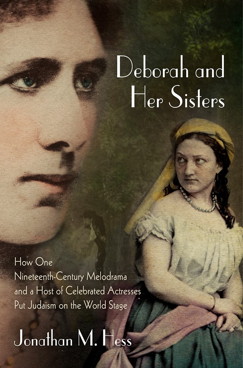
For a sixty-year period, Deborah and its many offshoots provided audiences with the ultimate feel-good experience of tearful sympathy and liberal universalism. With Deborah and Her Sisters, Jonathan M. Hess offers the first comprehensive history of this transnational phenomenon, focusing on its unique ability to bring Jews and non-Jews together during a period of increasing antisemitism. Paying careful attention to local performances and the dynamics of transnational exchange, Hess asks that we take seriously the feelings this commercially successful drama provoked as it drove its diverse audiences to tears. Following a vast paper trail in theater archives and in the press, Deborah and Her Sisters reconstructs the allure that Jewishness held in nineteenth-century popular culture and explores how the Deborah sensation generated a liberal culture of compassion with Jewish suffering that extended beyond the theater walls.

Jonathan M. Hess is the Moses M. and Hannah L. Malkin Distinguished Professor of Jewish History and Culture and Chair of the Department of Germanic and Slavic Languages and Literatures at the University of North Carolina at Chapel Hill. He is author of several books, including Middlebrow Literature and the Making of German-Jewish Identity and Germans, Jews and the Claims of Modernity.
Puccini’s “Tosca” at The Metropolitan Opera

Giacomo Puccini’s Tosca will be playing at the New York Metropolitan Opera from December 31st – May 12th.

Sir David McVicar’s ravishing new production offers a splendid backdrop for two extraordinary sopranos sharing the title role of the jealous prima donna: Sonya Yoncheva (pictured above in La Traviata) and Anna Netrebko. Vittorio Grigolo and Marcelo Álvarez alternate in the role of Tosca’s revolutionary artist lover Cavaradossi, with Sir Bryn Terfel, Michael Volle, and Željko Lučić as the depraved police chief Scarpia. puccini-tosca-poster-1351609987-view-0Music Director Emeritus James Levine conducts.

Puccini’s melodrama about a volatile diva, a sadistic police chief, and an idealistic artist has offended and thrilled audiences for more than a century. Critics, for their part, have often had problems with Tosca’s rather grungy subject matter, the directness and intensity of its score, and the crowd-pleasing dramatic opportunities it provides for its lead roles. But these same aspects have made Tosca one of a handful of iconic works that seem to represent opera in the public imagination. Tosca’s popularity is further secured by a superb and exhilarating dramatic sweep, a driving score of abundant melody and theatrical shrewdness, and a career-defining title role.

Fall 2017

Dangerous Playgrounds: Hemispheric Imaginaries and Domestic Insecurity in Contemporary US Tourism Narratives

by Daniel Lanza Rivers

Abstract

This article explores a network of “dangerous playgrounds” narratives amid the backdrop of then President George W. Bush’s “War on Terror” and the revitalization of the “self-deportation movement” following the passage of SB1070. Tracing the journeys of young, white US American tourists traveling to Latin America to release their inhibitions, stories working in the dangerous playgrounds mode use figurations of insurrectionary violence to wed the narrative arc of the bildungsroman to the generic conventions of melodrama and horror, and so cast the Americas south of the US border as a source of danger to US American youth. By reading these narrative negotiations in relation to the legacies of US American hemispheric interventionism, post-9/11 immigration policy, and US American travel narratives, this article unpacks the ways Jessica Abel’s critically acclaimed comic La Perdida (2006) and the films Turistas (2006), Borderland (2007), The Ruins (2008), and Indigenous (2014) create slippages in meaning that project anxieties about terrorism and domestic security onto Latinx bodies and Latin American nations through figurations of imperiled white femininity. By using literary and cultural analysis to explore how popular sentiment, generic convention, and policy negotiations draw on, shape, and extend neo-Monroeist structures of feeling, this article ultimately finds that the emergence of domestic policies aimed at institutionalizing the surveillance of Latinx subjects arises in popular culture as a remarkably predictable narrative mode, which uses the conventions of adventure, melodrama, and horror to frame the nativist project of securing domestic borders and incarcerating and expelling undocumented Latinx subjects as one of the necessary compromises of a mature nation.

George Lippard’s “Theatre of Hell”: Apocalyptic Melodrama and Working-Class Spectatorship in the Quaker City

by Michael D’Alessandro

Abstract

This essay, “George Lippard’s ‘Theatre of Hell’: Apocalyptic Melodrama and Working-Class Spectatorship in the Quaker City,” centers on the best-selling sensation novel The Quaker City; or the Monks of Monk Hall (1844-45) and antebellum Philadelphia theatergoing. I claim that by reproducing climactic scenes from cheap-admission spectacle melodramas, Lippard activates the communion and the politics of working-class spectatorship within the reading experience itself. Several Quaker City scenes restage images of ruling-class collapse originating within Philadelphia’s working-class playhouses. Especially important is a dream sequence that follows the novel’s web-fingered, dwarfed doorman Devil-Bug and his fantasy about a crumbling Philadelphia monarchy. In this extended scene, Lippard imports and re-dramatizes earthquakes, revolutionary parades, storms, floods, and fires from several melodramas including The Last Days of Pompeii (1835), El Hyder, The Chief of the Ghaut Mountains (1839), and Undine, Spirit of the Waters (1841). In constructing Quaker City’s climactic motifs, Lippard attempts to galvanize a working-class, theatergoing readership already programmed to recognize the apocalyptic symbols of class conflict. More precisely, he seeks to channel this familiarity into an analogous overthrow of the ruling class in real life.

“Film Melodrama and Opera: La Tosca in Italian Cinema” by Bernhard Kuhn

Abstract:

This article focuses on the relationship between film melodrama and opera from an intermedial perspective. In addition to drawing on relevant literature in the fields of intermediality and melodrama studies, it incorporates literary and musicological theories. It argues that while opera and melodrama are related, the operatic and the melodramatic are distinct modes of artistic expression. Comparable to the melodramatic mode, the operatic mode appears in many media and is highly relevant for the Italian cinema. In the first part, the article distinguishes between the operatic and melodramatic mode and points to relevant elements of the relationship between melodrama, opera, and the Italian cinema. To illustrate significant aspects of this connection, the second part of this article reflects on two films based on Victorien Sardou’s drama La Tosca (1887): Carlo Koch’s Tosca (1941) and Luigi Magni’s La Tosca (1973). The two films incorporate operatic and melodramatic elements very differently. While in Koch’s version the musical discours is at times comparable to arias in opera, the film also incorporates instances of melodrama. Magni’s film, on the other hand, transforms Sardou’s drama into a musical film reminiscent of opera buffa. It communicates less on the affective level and rather evokes a cognitive reflection on Italy’s reality of the early 1970s.

Feels like home: Since You Went Away and the 1940s family melodrama

by Chad Newsom
Screen, Volume 58, Issue 3, 1 September 2017, Pages 285–308,
https://doi.org/10.1093/screen/hjx030

David O. Selznick’s Since You Went Away (John Cromwell, 1944) is a meandering, three-hour film about one year in the everyday life of an average American household while the father is away at war. The film prompted a flood of letters to Selznick from soldiers who saw in the film not only glimpses of their own homes and families but also a concrete reason to fight or even die in battle. In one of these letters a soldier tells a clumsy, long-winded anecdote that nonetheless ends with a punch. He recalls conversing with a young child and realizing that the child’s sense of reality was largely formed by Hollywood cinema’s image bank. Only a child, he initially assumes, would find such fiction credible. But the soldier then connects this anecdote to his experience of…